
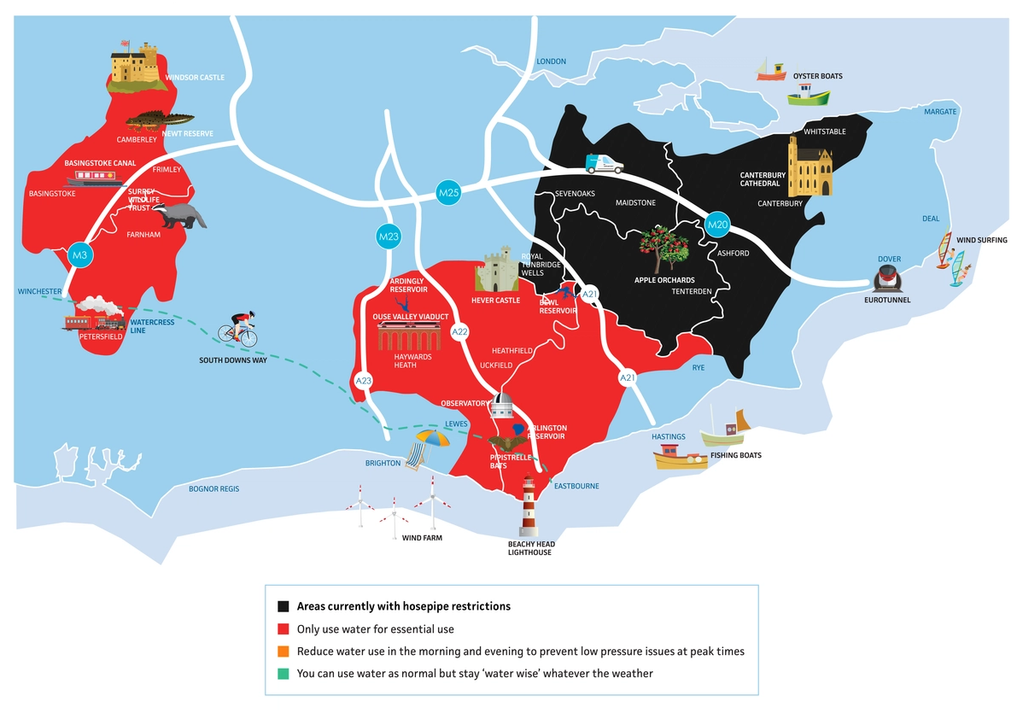
With immediate effect, we’ve introduced hosepipe restrictions across our supply area in Kent.
Due to high temperatures and record demand for water across Kent, a Temporary Use Ban (hosepipe restrictions) is now in place for customers in our Kent supply area.
Why are we doing this?
Due to sustained high temperatures and near record levels of demand for treated drinking water across Kent, we have made the difficult but necessary decision to introduce a Temporary Use Ban (hosepipe restrictions) for customers in our Kent region.
While we’ve worked to sustain supplies, the continued pressure on our network means we now need to reduce non-essential water use.
Introducing a Temporary Use Ban will help protect local water resources and ensure we can continue to provide a reliable supply of drinking water to customers and essential services across the county.
We’re asking everyone across the county to please follow these restrictions straight away, to help us protect local water supplies. These restrictions will be enforced from 00:01 on Friday, 3 July.

What do these restrictions mean?
The restrictions mean that you should not use hosepipes for watering gardens, washing cars, patios and boats and for filling swimming and paddling pools.
We completely understand why everyone reaches for the hose when the weather gets this hot. It’s natural to want to enjoy our gardens and cool down, and we know how frustrating it is to hear that restrictions are coming into place.
Our teams have worked incredibly hard to prepare for this summer, but the sheer scale of this sustained heatwave means water is being drawn from our storage tanks faster than it can physically be treated and refilled. Our absolute priority has to be making sure there is always enough water for everyone’s essential daily needs—like hygiene, drinking and cooking—and that we protect our vulnerable customers.
What are we doing?
Despite producing up to more than 100 million litres of extra water a day—equivalent to supplying in the region of three towns the size of Maidstone—the demand for drinking water needs to be reduced to ensure that supply interruptions are not experienced across its network throughout the summer.
To manage this peak period, our operations team are working flat out with:
- Production at max capacity: Every single available water treatment works and source is running at full capacity.
- Leakage control: We have significantly increased the number of teams on the ground locating and fixing bursts and leaks to save every drop.
- Network optimisation: Operations teams are actively re-routing water across the network to support areas seeing the steepest drops in storage levels.
- County-wide scope: While recent infrastructure upgrades have improved resilience in Tunbridge Wells and Tonbridge from a repeat of winter's interruptions, this heatwave is draining storage tanks right across Kent, requiring this county-wide approach.
Do the restrictions apply to me?
If you live in Kent and you’re unsure whether the restrictions apply to your property, or who supplies your drinking water, you can check your water supplier by simply entering your postcode here.(opens in a new tab)
Frequently Asked Questions
To find out more about the restrictions in place, please look at our FAQs(opens in a new tab).
I think I should be exempt
There are exemptions that we apply to eligible customers. These fall into two categories:
- Customers that are on our Priority Services Register that are unable to make reasonable adjustments.
- Customers who need to use a hosepipe for other reasons, including animal welfare and business needs.
How to apply for a category 1 exemption
You can sign up to our Priority Services Register to become exempt if you identify with any of the below:
- Blind
- Chronic/Serious Illness
- Dementia
- Development Conditions
- Dialysis
- Partially Sighted
- Physical Impairment
- Restricted Hand Movement
- Temporary Hospital Recovery
- Unable to answer the door
How to apply for a category 2 exemption
The below activities are already exempt. However, if you wish to apply a note to your account to confirm your exemption, please click the button below.
- Health and safety
- Animal welfare
- Business need
- Recycled water use
- New lawn
- Trickling irrigation system
- Commercial watering
- New swimming pool
- Religious practice


Have a question?
If you have any questions about the Temporary Use Ban or how it affects you, please get in touch. Contact us here.(opens in a new tab)
Restrictions and exemptions
Hosepipe use
Restricted:
A “hosepipe” means anything designed, adapted or used to serve the same purpose as a hosepipe. This means that garden sprinklers and irrigation systems (outside of the exception), connected to the mains water supply, are all considered to be hosepipes, together with anything attached to them like pressure washers.
Exemptions:
- People who may find it hard to make adaptations and are registered with the South East Water’s Priority Service Register will be granted an automatic exemption to any of the restrictions and will receive notification of this directly. If you believe you should be on the Priority Services Register please register here.
- Where using a hosepipe for any of the restricted purposes is required for unavoidable health and safety, such as removing or minimising any risk to human or animal health or safety, or preventing or controlling the spread of causative agents or disease, this will not be restricted.
- Using a hosepipe where the welfare and/or health and safety of animals including fish is paramount will not be restricted.
- Using a hosepipe that is connected to a water butt or other recycled water storage system will not be restricted.
Gardens
Restricted:
Watering a garden using a hosepipe.
A “garden” is a private or public garden, a lawn, a park; a grass verge; an area of grass used for sport or recreation; an allotment used for non-commercial purposes; and any other green space.
A garden is not:
- Agricultural land,
- Land used in the course of a business for growing any crops, fruits, vegetables or other plants for sale or commercial use;
- Land used for National Plant Collection;
- A temporary garden or flower display (i.e. on show to the public for no more than 7 days); or
- Plants in an outdoor pot or in the ground under cover (under cover being in a greenhouse, outbuilding or under a permanent canopy).
Exemptions:
- Using a hosepipe to water an area of grass or outdoor artificial surfaces used for sport or recreation (on the active strip/ playing area only – not the whole grounds) when undertaken outside of daily peak hours that occur 8am to 10am and 5pm to 9pm.
- Drip or trickle irrigation watering systems, fitted with a pressure reducing valve and a timer, that are not handheld, that place water drip by drip directly onto the soil surface or beneath the soil surface, without any surface run off or dispersion of water through the air using a jet or mist; a fixed watering system; use of watering cans and not hoses.
- Watering of new lawns at domestic premises, where this cannot reasonably be undertaken with a watering can and the turf was laid before the onset of the ban, for a period of 4 weeks after being laid and when undertaken outside of daily peak hours that occur 8am to 10am and 5pm to 9pm.
- Watering trees, whips, saplings and hedging planted before the ban, in the last planting year, where this cannot be reasonably done by way of a watering can.
- Water food crops at domestic premises or private allotments, where this cannot be reasonably done by watering can.
Vehicles
Restricted:
Cleaning a private motor-vehicle (or a trailer for such a vehicle) using a hosepipe.
Exemptions:
- Where the cleaning is done as a service to customers in the course of a business or to clean public service or goods vehicles.
- Private motor vehicle does not mean taxis or goods vehicles or commercial vehicles.
Plants
Restricted:
Watering plants on domestic or other non-commercial premises using a hosepipe.
Exemptions:
- Watering plants (crops, vegetables or fruit) that are grown or kept for sale or commercial use, National Plant Collections or temporary garden or flower displays.
- Drip or trickle irrigation watering systems, fitted with a pressure reducing valve and a timer, that are not handheld, that place water drip by drip directly onto the soil surface or beneath the soil surface, without any surface run off or dispersion of water through the air using a jet or mist; a fixed watering system; use of watering cans and not hoses.
Boats
Restricted:
Cleaning a private leisure boat using a hosepipe.
Exemptions:
- Where this is done as a service to customers in the course of a business or to clean public service or goods vehicles.
- This will not apply to the inside of your boat.
Pools
Restricted:
Filling or maintaining a domestic swimming or paddling pool (this would include constructed, non inflatable hot tubs).
Exemptions:
- Where you do this with a water conservation recycling system or hand held container.
- Filling or maintaining a permanent swimming pool where necessary in the course of its construction or where it is designed, constructed or adapted for use in the course of medical treatment.
- When the pool is within places of worship or community pools and when they are used as part of a religious ceremony.
Domestic recreational use
Restricted:
Drawing water, using a hosepipe, for domestic recreational use (such as hot tubs of all kinds and inflatable paddling pools).
Exemptions:
- Filling a fixed structure from empty after construction or significant refurbishment. In this case significant refurbishment should be treated as equivalent to construction. Once it has been refilled then a hosepipe cannot be used for any subsequent filling.
Ponds
Restricted:
Filling or maintaining a domestic pond (manmade or natural) using a hosepipe.
Exemptions:
- Where this is for the welfare of the fish or aquatic animals in the pond.
Ornamental fountains
Restricted:
Filling or maintaining an ornamental fountain (including a cascade or any other display of moving water, and includes filling by permanent plumbing).
Exemptions:
- Where this is used as part of recognised religious practices.
Cleaning
Restricted:
Cleaning walls, or windows, of domestic premises using a hosepipe.
Exemptions:
- Where this is done as a service to customers in the course of a business or to clean public service or goods vehicles.
Paths and patios
Restricted:
Cleaning paths or patios using a hosepipe.
Exemptions:
- Where this is done as a service to customers in the course of a business or to clean public service or goods vehicles.
Artificial outdoor surfaces
Restricted:
Cleaning other artificial outdoor surfaces using a hosepipe.
Exemptions:
- Where this is done as a service to customers in the course of a business or to clean public service or goods vehicles.
Report water misuse


We’ve introduced a Temporary Use Ban (TUB) and they are now enforceable.
If you want to report someone for still using their hosepipe or sprinkler please click here.