
From 1 April, the average drinking water bill has increased by seven per cent, this includes all customers, and covers a range of tariffs.
The increase you see on your bill may be different from the average bill and it also includes waste water charges. The waste water companies have their own price changes.
Why are prices going up?
We know that any increase in costs can be difficult, especially right now, and we haven’t taken the decision lightly.
Our regulator Ofwat decides the level of investment we can make in our network, and the total amount we can charge our customers over a five year period, so prices are fair for customers.
We're investing £2.1 billion over the next five years to improve how we deliver drinking water and to make sure you can rely on a safe, secure water supply today and for years to come.
No dividends have been paid to our ultimate shareholders since 2019 and there are no plans to pay any in the next financial year.
You can find out more about the price review process here.(opens in a new tab)
How much is my bill going up by?
The average water bill now costs 89p per day.
This is an increase of seven per cent for an average bill. This includes all customers, and covers a range of tariffs - metered, unmetered and rateable value.
The increase you see on your bill may be different from the average bill. We have published the full details of our water charges here.
What about waste water charges?
The waste water companies have their own price changes. Generally it costs more to remove and treat the dirty water than it does to supply fresh water, so waste water charges tend to be higher.
We bill our customers for waste water services on behalf of Southern Water, Thames Water, Severn Trent Connect and Last Mile Water. We do this to make things simpler for our shared customers.
Not sure who your waste water supplier is? You can find this on your bill, or use this link(opens in a new tab).
What this means for you
If you pay monthly
You will see your monthly payment go up from your next bill.
If you’re on a meter and you pay your bill in full when it’s due
When you receive your next bill after 1 April 2026, you will see the price rise reflected in this bill.
If you’re not on a meter and you pay your bill in full or in instalments
The bill you have received most recently is for the period April 2026 to March 2027. You will see an increase in the cost compared to your previous bill, to reflect the price rise.
Want to switch to a monthly payment plan?




Your opinion matters
If you’d like to let us know your feedback or thoughts on our investment plans, please use our online contact form to complete and return the feedback form included within your most recent bill.
Talking about money can be tough
Please don’t worry if you’re struggling to pay your bill.
We have a range of schemes to help. The best thing to do is to get in touch with us.


What the increase will fund

In Kent
- Pembury water treatment works:
At our site in Pembury we’re upgrading equipment between our water treatment works and the local drinking water storage tank. This equipment will help us monitor the flow of water between the sites and detect any changes sooner. You can find out more about this here. - Sevenoaks and Tunbridge Wells pipeline upgrades:
Pipeline improvements begin early this year for Queen’s Drive (Sevenoaks) and Kentish Gardens (Tunbridge Wells). Work is already underway in Chipstead Park, replacing pipes that have burst frequently, leaving some of our customers with low pressure and sometimes no water at all. - £39 million water treatment works near Aylesford:
We’re investing £39 million in a state-of-the-art treatment works near Aylesford to make Kent’s supply more reliable. Up and running from spring 2026, it’ll treat an extra 20 million litres of water a day for the Ashford and Maidstone areas. You can find out more about this here. - Broad Oak Water - a proposed new reservoir near Canterbury:
Today’s environmental needs make it vital to plan now. We’re currently designing it and aim to apply for planning permission in 2028. Once built, Broad Oak Water will secure a reliable and sustainable water supply while creating new wildlife habitats and community benefits. Find out more here. - £8 million investment in Canterbury:
Over the next five years, we’re investing £8 million in the Canterbury area to improve water supply, installing new fittings, metres and 2.7 kilometres of new pipes. Find out more here. - Local farmers and landowners partnership:
We’re working with local landowners and farmers, providing expert advice and funding to protect water quality and availability. Our partnership helps safeguard water sources for the future. You can find out more about this here.
In Sussex
- Punnetts Town and Hailsham investment (£12.6 million):
We know our water supply in Punnetts Town is not the standard we want for you. So, we’ve replaced 6.5 kilometres of pipes to improve your drinking water quality and reduce common issues like discoloured water. You can find out more about this work here.
We’re also upgrading the Amberstone pumping station, and laying 8.5 kilometres of new pipeline to support our growing community with better water pressure and less bursts. This work will improve network reliability and flexibility in the area. You can find out more about this work here. - Protecting groundwater at Lullington Heath:
At Lullington Heath (Seven Sisters National Nature Reserve), we’re working with partners to use natural methods to improve the quality and quantity of water filtering into the chalk aquifer (underground layers of rock that hold water).
This new national nature reserve, launching in March this year, is dedicated to protecting groundwater. - Supporting efficient water use in Litlington:
We’re helping Litlington farmers trial new solar-powered meters. This technology gives them real-time data on their water use, helping them to find and fix leaks and use water more efficiently on their farms. You can find out more about this work here. - East Grinstead investment (£9 million):
We’re investing £9 million in East Grinstead to replace 9 kilometres of pipe and laying approximately 3 kilometres of new pipeline to increase the amount of water flowing into the area.
This will take place over several projects and details will be shared as planning progresses. - Haywards Heath investment (£1.2 million):
We’re investing £1.2 million replacing 2.3 kilometres of ageing, burst-prone pipes. We’re also progressing with a £1 million scheme to replace a vital network section running from Barcombe to Horsted Keynes. - Royal Botanic Gardens, Kew:
We’ve partnered with the Royal Botanic Gardens in Kew to supply safe nests for Sand Martins and Terns. You can find out more about this here. - River Ouse algae:
We’re addressing high levels of algae in the upstream catchment of the River Ouse. This will help to prevent further decline in raw water quality at our Shellbrook water treatment works near Ardingly Reservoir.
In Berkshire, Hampshire and Surrey
- Filmorehill Lane, Privett:
We’re replacing around 1.2 kilometres of water pipes because they are prone to burst. The water pipes in the Privett area have burst eight times in the last five years, leaving some customers with low water pressure or no water at all, which is not the standard we want to provide. You can find out more about this work here. - The Maidenhead Ditch:
We’re working to protect the Maidenhead Ditch and keep it healthy and sustainable for the future by improving wildlife habitats and creating wetlands to boost biodiversity. You can find out more about this here. - Upgraded meters:
We’re also installing upgraded meters for you and your neighbours by 2035. Our smart meter programme began in January 2026 and when connected to smart meter technology your meter will:
- Automatically measure how much water you use each day.
- Help us detect leaks early.
- Give you better control over your bill.
You can find out more about our meter upgrade programme here.
FAQs
Understanding your bill increase
We know that any increase in costs can be difficult, especially right now, and we haven’t taken the decision lightly. To ensure we continue to invest in making your drinking water supply more reliable by reducing leaks and improving our network, we need to increase investment and therefore prices.
The average water bill now costs 89p per day. This is an increase of seven per cent compared to last year. However, when compared to the price of bottled water, your tap water remains extremely good value for money.
Seven per cent is the increase for the "average" household bill. However, actual bills vary based on several factors:
- Usage: If you are on a meter and use more water than the average household, your bill will be higher.
- Waste Water: Your bill likely includes sewerage charges collected on behalf of other companies (like Southern Water or Thames Water). These companies set their own price changes which may differ from ours.
- Payment Plans: If you pay monthly, we may have adjusted your payments to cover any outstanding balance on your account as well as the price increase.
Water bill rises are often "front-loaded," meaning the biggest increases occur in the first year of our five-year business plan. This allows us to quickly fund substantial infrastructure upgrades required immediately. From 1 April 2026, the average bill is predicted to be £324 (89p a day).
The price we charge from 1 April 2027 will be confirmed by 31 January 2027. We have asked Ofwat to refer its decision on our latest Business Plan to the Competition and Markets Authority (CMA) for an independent review, so charges for 2026/27 do not yet reflect the final decision of the CMA.
Help if you are struggling to pay
We are here to help. We have a range of tariffs available, including our Social Tariff, which applies a tiered discount based on household income:
- Income between £17,000 and £22,020: 30% discount.
- Income less than £17,000: 50% discount.
Please visit southeastwater.co.uk/helpwithyourbill to apply or to see water-saving tips and free devices that can help reduce your usage.
While you cannot change your water supplier, the industry regulator, Ofwat, strictly controls our prices. They decide the level of investment we can make and the total amount we can charge to ensure prices remain fair.
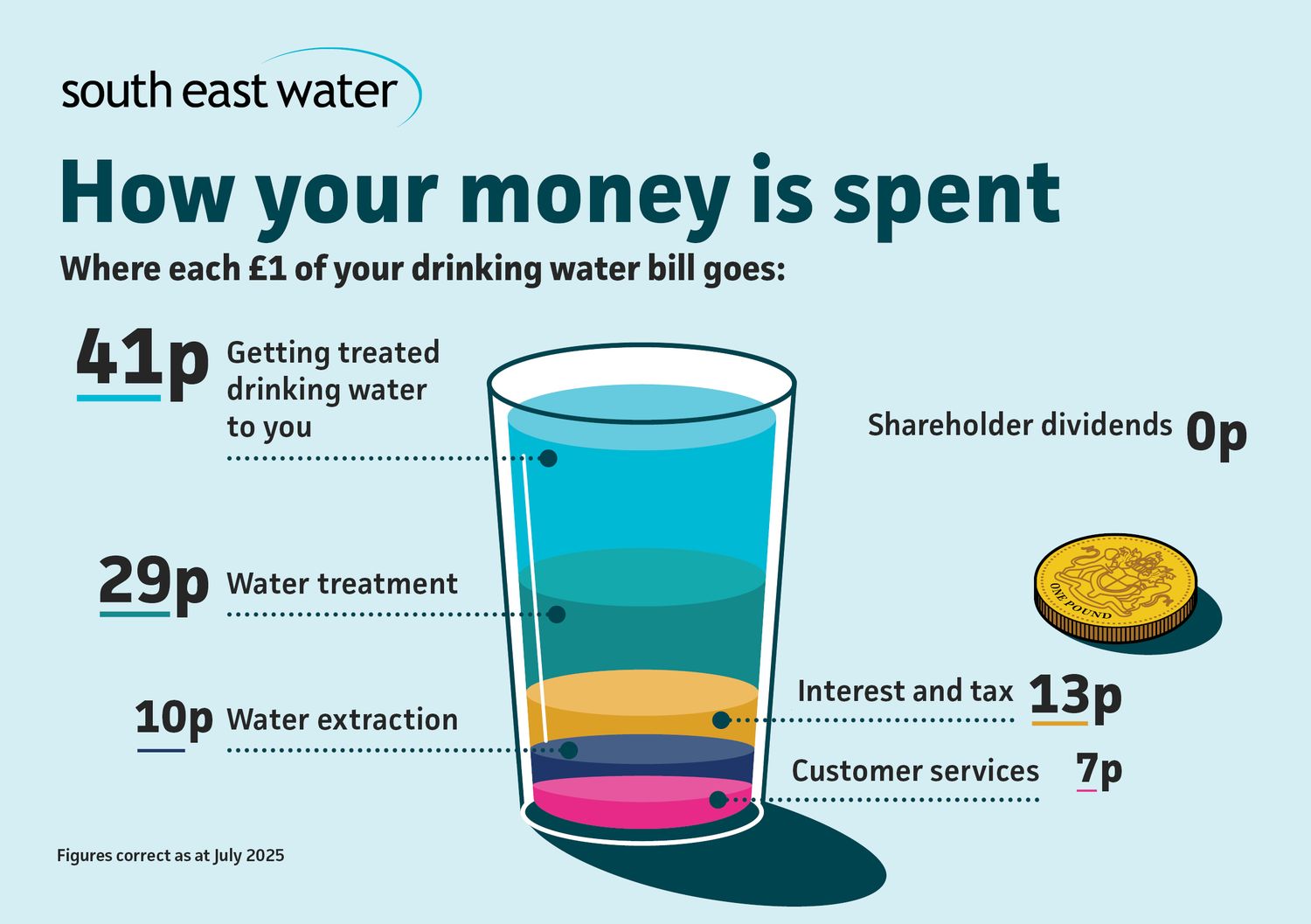
How your money is spent
Shareholders: No dividends have been paid to our ultimate shareholders since 2019, and there are no plans to pay any in the next financial year.
Bonuses: No bonus payments were made to directors for operational performance for the year 2024/25. We are committed to a pay structure that rewards success but does not reward poor performance.
We share your frustration regarding leaks. We currently spend around £40 million a year finding and fixing leaks. Last year, we repaired over 18,000 leaks—a 12% increase on the previous year. We are investing £2.1 billion over the next five years to improve the network and reduce leakage further.
No. South East Water is a drinking water only company. We do not manage sewage. Any fines issued to wastewater companies (like Southern Water or Thames Water) are paid by those companies and are not passed on to customers via bills.
Compensation
We are very sorry for the recent disruption. The price increase was determined via our Business Plan agreed in December 2024, prior to these incidents.
However, we have a statutory compensation scheme in place.
- Household Customers: You do not need to contact us. Compensation is processed automatically and applied as a credit to your account within 20 working days.
- Business Customers: Compensation will be processed through your water retailer.
No. Compensation payments do not come from customer bills; they are penalties paid by the business.
Comparison with other companies
Like us, all water companies have gone through a price-setting process approved by Ofwat. However, waste water (sewerage) charges are determined by the waste water provider in your area.
No two water companies charge the same. Prices depend heavily on the geography of the supply area:
- Rural vs. Urban: We supply many rural areas, requiring more pipework per property than city-based companies.
- Water Source: The majority of our water comes from underground aquifers (chalk rock that holds water), which requires different extraction and treatment methods compared to companies that rely on surface reservoirs.
Payment plans and Direct Debits
Our payment plans are designed as a "pay as you go" arrangement. We adjust monthly payments in advance to ensure that when your bill is produced, you have paid enough to cover it in full, including the upcoming price increase.
No. Our monthly payment plans are designed to spread the cost so the bill is paid in full by the time it is generated. If you prefer not to pay in advance, the alternative is to pay the full bill amount immediately upon receipt.
We do not need a specific meter reading on 1 April. We take your consumption between your last reading and your next one, calculate your daily average usage, and apply the old tariff to days before 1 April and the new tariff to days after.
Assessed charges
If a meter cannot be installed at your property, we use an Assessed Charge. This is calculated based on the average water use for properties with the same number of bedrooms.
Note: This is based on the number of bedrooms, not the number of occupiers.
Advice on consumer websites often refers to the industry generally. However, policies vary by company. Our regulator-approved Charges Scheme calculates Assessed Charges based on bedrooms to ensure consistency across our region.
No. As correctly stated on many consumer advice sites (including MoneySavingExpert), South East Water customers cannot revert to unmetered charges once a meter has been installed.
Hosepipe restrictions
Hosepipe restrictions for customers across Kent and Sussex were lifted on Thursday 5 February.
We’d like to thank all our customers for following the restrictions. We appreciate that they impacted the way you use water and how you carry out your daily tasks. We’re able to now lift the restrictions because the levels in our reservoirs and our underground water sources are back to normal, following the rain that we’ve had over winter.
Visit here for more information.